Defects beneath the clear coat
Metallic flake, base-coat mottling and sanding marks under the film cannot be polished out. We document them with a raking-light photo and refer the panel to a paint shop.
Referral: panel refinish
Inspection and stages
No studio can quote a polish honestly without first reading the paint. This page sets out what we measure, the three polishing stages with their stated clear coat removal, what the finished assessment contains, and the limits we publish rather than hide.
Inspection protocol
Five ordered steps, 90 to 120 minutes. No polishing happens on inspection day: the dossier is the deliverable, and the fee is ₴1,800 for a passenger car or ₴2,400 for an SUV or large vehicle.
Two-bucket wash, tar and iron removal, then a clay pass so the readings describe paint, not fallout. Contaminated panels are logged before any gauge touches them.
Ultrasonic thickness readings on every panel, three points per panel, recorded in microns with the gauge model and date noted. This baseline sets the ceiling for clear-coat removal later.
Swashes, pigtails, etching and sanding marks are sketched panel by panel at 5,500 K neutral light, with depth judged by whether a defect catches a fingernail.
A narrow beam at a shallow angle reveals what daylight hides. Each panel gets a pass angle, a photograph reference and a severity grade, so nothing depends on memory.
You receive the panel ledger, the measured film build, a recommended stage or a written recommendation against polishing, and the 30-day credit against a booked stage.
Roughly a third of inspected vehicles are advised against machine polishing. That recommendation is written into the same document, at no extra charge.
Polish stages
No stage is booked until the inspection reading clears its minimum. Starting prices refer to a passenger car body; SUV and large-panel vehicles are quoted after the assessment.
| Stage | Defects addressed | Clear-coat removal | Inspection prerequisite | Time | From price |
|---|---|---|---|---|---|
| Stage ASingle-stage refinement | Wash marring, fine swirls, light haze on gloss panels | 1 to 2 microns | Film build of at least 95 microns on every panel | 4 to 6 h | ₴6,800 |
| Stage BTwo-stage correction | Rotary holograms, random deep swirls, moderate oxidation | 3 to 5 microns | Film build of at least 110 microns, no failing panel | 8 to 12 h | ₴12,400 |
| Stage CFull correction | Heavy defect density, sanding marks, restored or repainted panels | 5 to 8 microns | Film build of at least 125 microns after spot mapping | 14 to 20 h | ₴19,600 |
The paid inspection (₴1,800 for a passenger car, ₴2,400 for SUV and large bodies, 90 to 120 minutes) is credited in full against any stage booked within 30 days. Roughly a third of inspected vehicles are recommended against machine polishing, and that answer is given in writing. See pricing notes for what a stage excludes, or book an inspection slot.
Fees and confirmation
Polishing prices depend on measured clear-coat thickness and on how many panels need correction, so we quote only after the panel scan. Stage prices are confirmed in writing at the end of the inspection and signed by both sides before any machine touches the paint.
Evidence
Every inspected vehicle leaves with a specimen dossier: panel-by-panel readings, raking-light photographs taken at a fixed angle, and a signed recommendation. No polishing begins before that file exists.
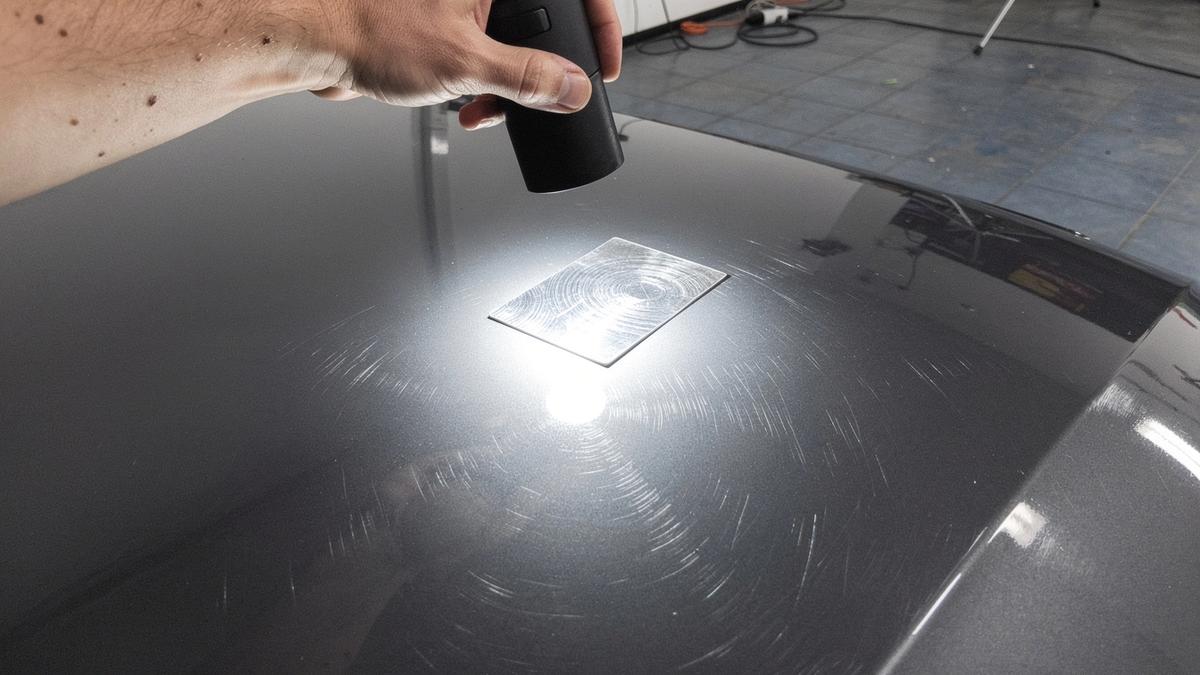 01 Swirl cluster, 104 µm film
02 Lamp angle 15°
Published limits
About one in three inspected vehicles leaves with a recommendation against machine polishing. When a defect sits under the clear coat, the honest repair is repainting or panel replacement, not a more aggressive pad.
Metallic flake, base-coat mottling and sanding marks under the film cannot be polished out. We document them with a raking-light photo and refer the panel to a paint shop.
Referral: panel refinish
If the edge catches, the damage has passed the clear coat. We may still improve the appearance, but we will not promise removal or a factory finish.
Alternative: touch-up and blend
Hazing, crows feet and lifting edges signal a coating failure. Polishing only moves the failure around. The panel needs stripping and recoating.
Referral: body shop
If the gauge reads below our safe threshold, we stop. The inspection report records the reading per panel and the polishing stage is declined in writing.
Outcome: no polish approved
These are missing or displaced material, not surface haze. We refer chips and creases to a paint specialist and shallow dents to paintless dent removal.
Alternative: PDR or paint repair
Deep bird-dropping or water-spot etching can expose the base coat. Correction will flatten the edge but cannot restore what is gone.
Alternative: spot repair